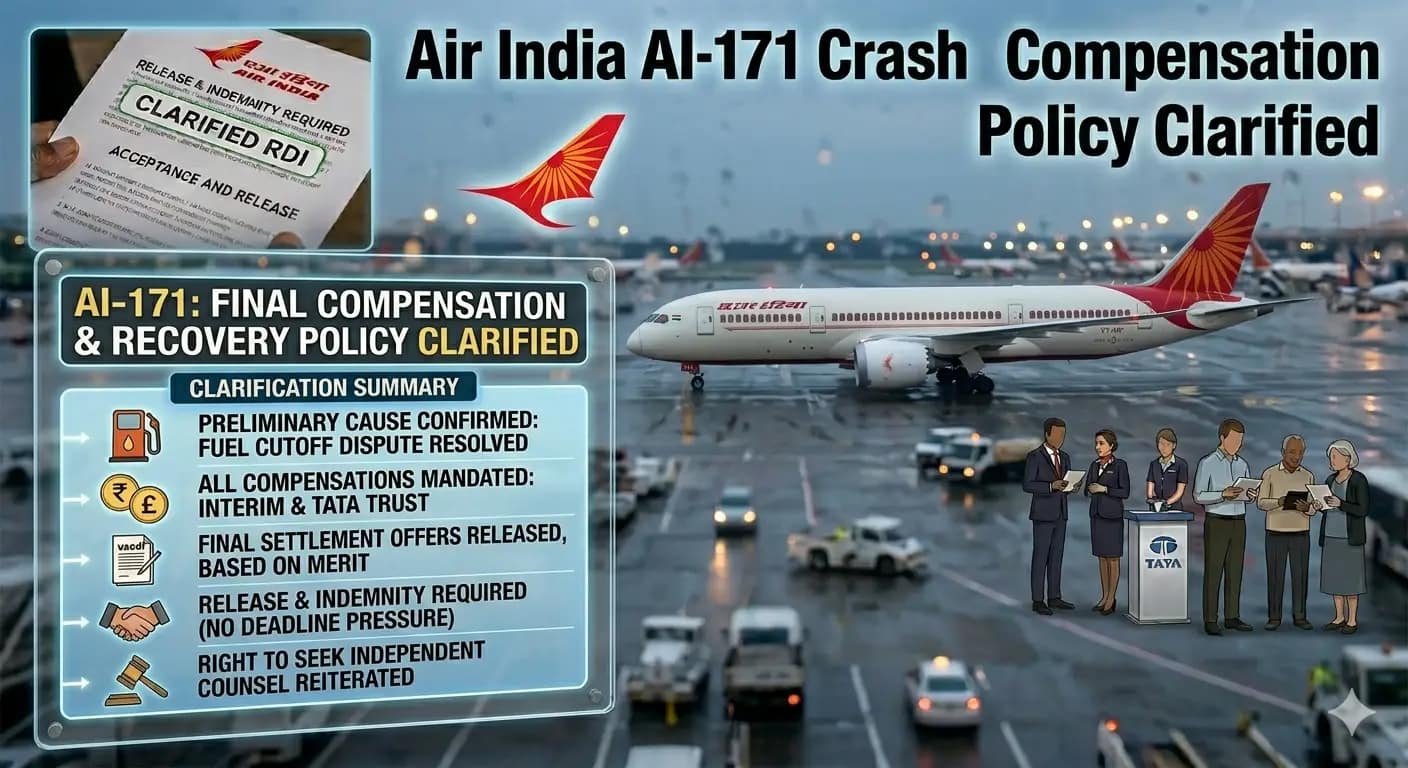
NEW DELHI — In a major development ahead of the first anniversary of the tragic aviation disaster, Tata Group-owned Air India has issued a comprehensive clarification regarding its Air India AI-171 crash compensation policy. The airline has strongly refuted allegations that it is pressuring the families of the victims to sign definitive legal waivers.
The controversy erupted after family members of those who lost their lives in the devastating Ahmedabad plane crash raised serious concerns about a broad indemnity clause included in the final settlement documents. Air India responded officially on Wednesday, 10 June 2026, stating that there is absolutely no deadline or coercion being applied to the grieving relatives.
The Controversy Surrounding the Legal Waiver Clause
The public debate intensified after Radhika Mishra, the daughter of a prominent public figure who died in the disaster, sent an email directly to Tata Sons and Air India Chairman N. Chandrasekaran. In her communication, Mishra strongly opposed the mandatory Ahmedabad plane crash legal waiver, arguing that it requires families to permanently relinquish their present and future legal rights before the official investigation has even concluded.
Seeking an Undertaking from Grieving Families
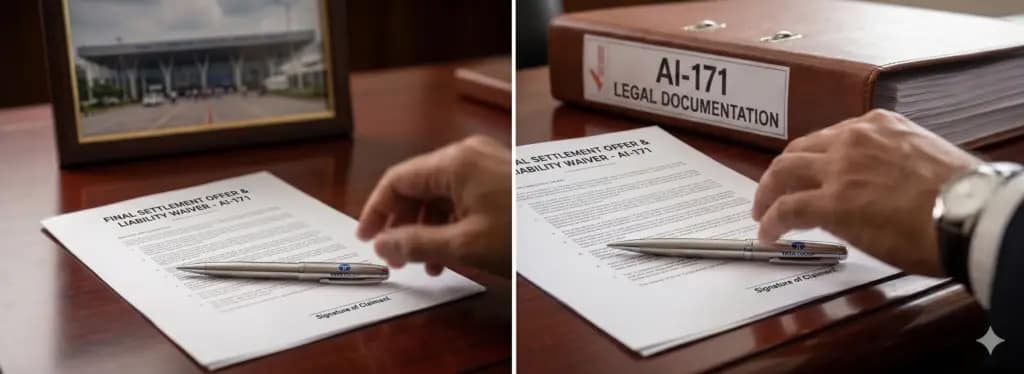
As part of its final settlement process, the airline requested that families sign a Receipt, Discharge & Indemnity (RDI) document. This document acts as an undertaking that the recipient will not pursue future legal actions or make financial claims against:
- Air India and its affiliates
- Original Equipment Manufacturers (OEMs) including Boeing, General Electric, and Honeywell
- Airport operators and local navigation stakeholders
Lawyers representing several victims from India and abroad (including the UK, Canada, and Portugal) flagged this clause as overly restrictive, cautioning that families could lose significant legal leverage if structural or mechanical negligence is later confirmed by investigators.
2. Air India Denies Coercion and Timetable Pressures
Responding directly to these concerns, Air India clarified that its Air India final settlement offer does not carry an expiration date. The airline emphasized that it wanted to give families choices rather than impose restrictions.
“There is absolutely no deadline or pressure on any family or individual to accept our offer within a set timeframe. It is for this reason that our offer of final compensation did not set out any timetable for acceptance,” the airline stated in an official communication.
Why the Settlement Was Launched Early
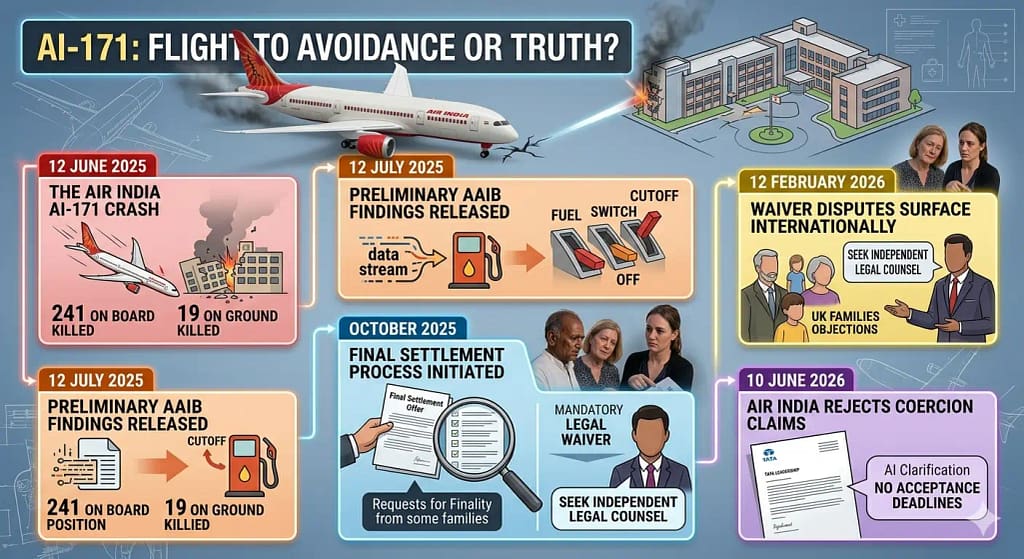
Air India explained that the decision to introduce the final payout mechanism in October 2025—months before the release of the final accident report—was a direct response to numerous financial requests from the victims’ relatives. The airline noted that it would be inherently unfair to place the compensation process on hold indefinitely for families who prefer immediate closure and financial resolution over waiting years for regulatory reports.
3. The Role of the AAIB Crash Investigation Report
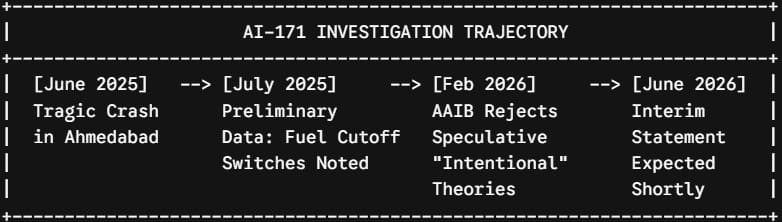
A central point of friction for the families is that the Aircraft Accident Investigation Bureau (AAIB) has not yet published its final findings.
Under protocols established by the International Civil Aviation Organization (ICAO), final accident reports are ideally expected within 12 months. However, given the extraordinary technical complexity of the AI-171 disaster, the AAIB is likely to issue an interim status statement on the upcoming anniversary rather than a definitive final conclusion.
Explaining the Technical Breakdown
The preliminary data released in July 2025 revealed an incredibly rare phenomenon: just three seconds after taking off from Sardar Vallabhbhai Patel International Airport in Ahmedabad, both Engine 1 and Engine 2 fuel cutoff switches transitioned from “RUN” to “CUTOFF” within a single second. This completely starved the Boeing 787-8 Dreamliner of fuel, causing it to crash into the doctors’ hostel complex of B.J. Medical College in the Meghaninagar area.
Two conflicting technical theories continue to dominate discussion:
Pilot Error: An accidental or deliberate movement of the fuel switches by the flight crew.
Mechanical Fault: A systemic electronic or physical latch failure within the Dreamliner’s control column. The urgency of this theory was heightened when another Air India flight on a London-to-Bengaluru route encountered temporary fuel-switch latch irregularities during an engine startup, prompting Indian aviation regulators to ship the component to Boeing headquarters in the United States for testing.
4. Financial Structure of the AI-171 Compensation Package
To understand the scope of the current offers, it is essential to look at the multi-tiered financial structure established by the airline and its parent group. The total package consists of immediate interim relief, ex-gratia trust disbursements, and custom final settlements.
Breakdown of Compensation Tiers
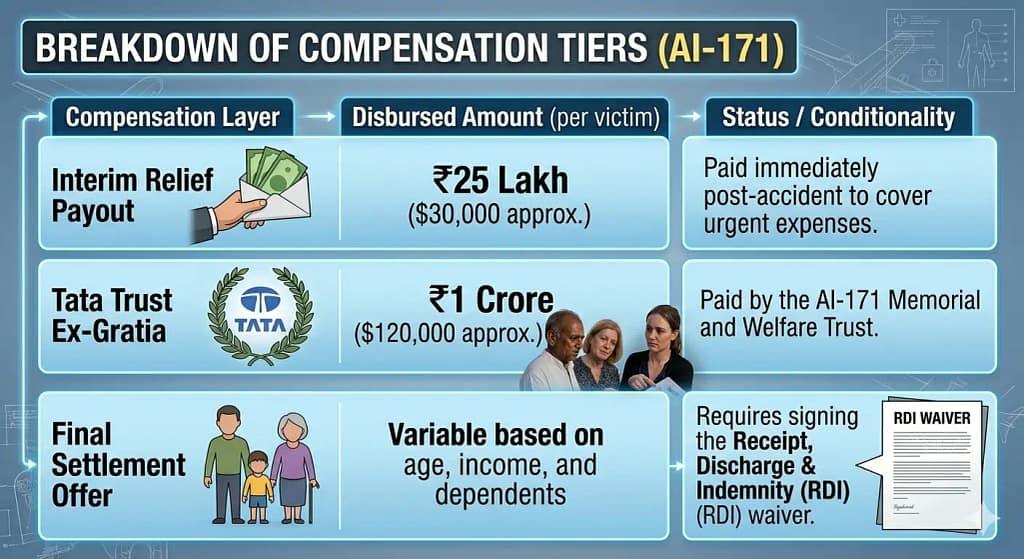
Air India maintains that the broad language used in the RDI document is standard industry practice globally. It is designed to ensure that once a case is closed, the airline is shielded from cross-claims or secondary legal challenges stemming from different members of the same family or third-party suppliers.
5. Global Liability Frameworks and the Montreal Convention
For Indian aviation consumers, understanding the legal underpinnings of an air crash is vital. The compensation architecture for international flights is strictly governed by the Montreal Convention, an international treaty to which India is a signatory.
Under this framework, airlines face a two-tier system of liability:
- Strict Liability Tier: Airlines are strictly liable for passenger damages up to a specific statutory threshold, currently valued at approximately 151,880 Special Drawing Rights (SDR), which translates roughly to ₹2 Crore ($240,000) per passenger. The airline cannot contest this tier, regardless of fault.
- Unlimited Liability Tier: If families can legally prove that the accident was caused by the willful negligence, omission, or wrongful act of the airline, its staff, or its manufacturing partners, the liability threshold becomes unlimited.
Because the final AAIB crash investigation report holds the key to proving or disproving negligence, legal experts across major Indian cities like New Delhi and Mumbai are advising families to carefully weigh their options before giving up their rights under the Montreal Convention framework.
6. Comprehensive Timeline of Events
7. Expert Legal Opinions for Indian Aviation Consumers
Legal commentators note that the intersection of corporate settlement strategies and emotional trauma requires extreme transparency. Air India’s clarification effectively splits the affected families into two distinct pathways:
- Path A (Immediate Settlement): Families facing financial vulnerabilities or seeking rapid personal closure can choose to accept the current custom corporate evaluation and sign the RDI waiver immediately.
- Path B (Deffered Decision): Families who wish to discover the exact technical root cause of the accident retain full legal flexibility to stall their signatures until the AAIB publishes its exhaustive findings.
Aviation lawyers emphasize that choosing Path B does not invalidate or reduce a family’s base entitlement under international law. Air India has explicitly confirmed that the settlement offers will remain open and active for those who choose to wait.
Conclusion: Key Takeaways for Affected Families
The latest clarification from Air India provides much-needed reassurance to the families of the 260 individuals who lost their lives in the Ahmedabad tragedy. The key takeaways from the airline’s latest policy announcement are:
- No Deadlines: There is no ticking clock; families can take months or even years to deliberate on the final corporate offer.
- No Legal Coercion: Relatives are completely free to wait for the comprehensive independent AAIB report before deciding whether to surrender their right to sue.
- Standard Industry Practice: The controversial indemnity language is designed to ensure settlement finality for the airline, rather than a malicious attempt to protect manufacturing corporations.
As the nation marks the solemn first anniversary of the AI-171 tragedy, the focus remains firmly on transparency, compassion, and the pursuit of ultimate safety answers from the investigators.
Frequently Asked Questions (FAQs)
Q1: Can families accept the final settlement but still sue Boeing or other manufacturers later?
No. The current terms of Air India’s Receipt, Discharge & Indemnity (RDI) document require a full waiver of future claims against both the airline and its original equipment manufacturers (OEMs) like Boeing and General Electric.
Q2: What happens if a family refuses to sign the waiver right now?
Nothing punitive happens. The final settlement offer remains open. Families can choose to wait for the complete AAIB crash investigation report to see if corporate or mechanical negligence is established before making their decision.
Q3: Does the waiver affect the interim relief or the Tata trust payments?
No. The interim relief of ₹25 Lakh and the Tata Group aviation ex-gratia payment of ₹1 Crore from the AI-171 Memorial and Welfare Trust have already been distributed to almost all verified families and are completely independent of the final settlement waiver.
Q4: How does the Montreal Convention protect Indian passengers in this case?
The Montreal Convention airline liability rules state that the carrier is strictly liable for up to approximately ₹2 Crore per passenger without families needing to prove fault. Higher compensation amounts can be pursued through court if systemic operational negligence is discovered.
Call to Action for Readers: What are your thoughts on how airlines handle compensation after major disasters? Do you believe legal waivers should be banned until official accident reports are made public? Share your viewpoints in the comments below or share this article to spread awareness about aviation consumer rights in India.