
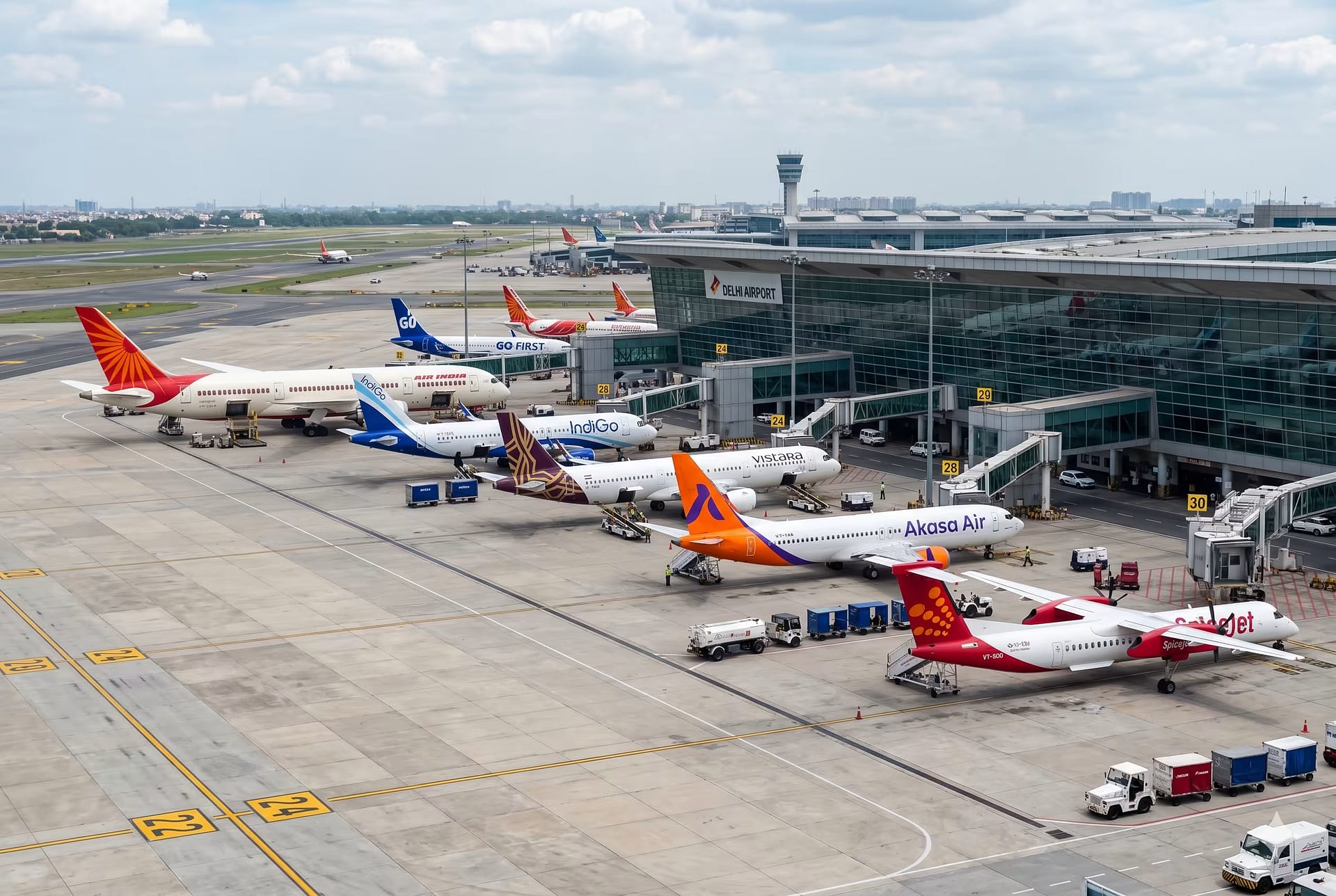
India’s scheduled airline fleet has crossed a major milestone, with the latest official operator list showing 822 aircraft across scheduled and scheduled commuter airlines as of 31 May 2026. This matters for India because a larger fleet usually means more routes, more seats, and better connectivity for travellers across metro and non-metro cities.
What the latest list shows
The updated list of scheduled and scheduled commuter operators gives a clear snapshot of India’s commercial airline network in 2026. It includes major full-service carriers, low-cost airlines, regional operators, and cargo airlines, showing how broad the aviation market has become.
Key numbers from the report
- Air India has a mixed fleet of wide-body and narrow-body aircraft, including B777s, B787s, A320 family aircraft, A350s, and ATR72-600s.
- Air India Express operates Boeing 737 family aircraft and cargo versions, with a fleet built mainly for domestic and short-haul international flying.
- IndiGo remains the biggest operator in the list by aircraft count, with large numbers of A320neo, A321neo, and A320ceo family aircraft.
- Akasa Air, FLY91, Star Air, Alliance Air, SpiceJet, Blue Dart Aviation, Quikjet, India One Air, and Skyhop Aviation also appear in the updated operator list.
- The list is dated 31 May 2026 and includes validity dates for AOC approvals, which shows the regulatory status of each operator.
Background and context
An Air Operator Certificate, or AOC, is the official approval an airline needs to fly commercial services in India. The monthly or periodic operator list is important because it tells readers which airlines are active, what aircraft they use, and how many registered aircraft they have in service.
For Indian aviation, this kind of updated fleet list is more than a technical document. It reflects the scale of growth in passenger demand, the rise of regional flying, and the shift towards newer aircraft types such as the A320neo, A321neo, A350, B737-8, and ATR72-600.
Fleet details by airline

Air India’s fleet is the most diverse in the document, with long-haul aircraft like the B777-300ER, B787-9, and A350-941, along with short-haul aircraft like the A320 family and ATR72-600. The airline’s wide-body fleet is especially important for long international routes from India.
Air India Express is focused on Boeing 737 aircraft, including the B737-8, B737-800, and freighter aircraft. This gives the airline flexibility for domestic, Gulf, and other short- to medium-haul routes.
IndiGo appears with a very large fleet across several Airbus models, including A320-232, A320-214, A320-271N, A320-251N, and A321-271NX aircraft. The document shows IndiGo operating both passenger and cargo configurations, which is useful as Indian airlines increasingly diversify their business.
Other notable operators include:
- Alliance Air, which continues to operate ATR72-600 aircraft and smaller turboprop aircraft for regional connectivity.
- Star Air, which uses EMB-145 and EMB-170 aircraft for regional routes.
- FLY91, a newer regional airline using ATR72-600 aircraft.
- SpiceJet, which has a mix of Boeing 737s and Q400 turboprops.
- Cargo specialists like Blue Dart Aviation and Quikjet, which support e-commerce and freight movement.
Meaning for passengers and airlines

For passengers, a larger and more varied fleet usually means more flight options, better frequency, and improved chances of getting direct connections. This is especially useful for Indian travellers who fly between tier-2 and tier-3 cities as well as major metros.
For airlines, the mix of aircraft types shows a practical strategy. Narrow-body aircraft such as the A320neo and B737-8 are used for high-frequency short routes, while wide-body aircraft like the A350 and B787 are used for longer international sectors. Turboprop aircraft like the ATR72-600 help airlines serve smaller airports where jet operations may not be the best fit.
For the broader industry, the presence of cargo fleets alongside passenger fleets highlights how Indian aviation is now supporting both travel and logistics growth. This is important for express parcel movement, online retail deliveries, and time-sensitive freight.
What the data suggests
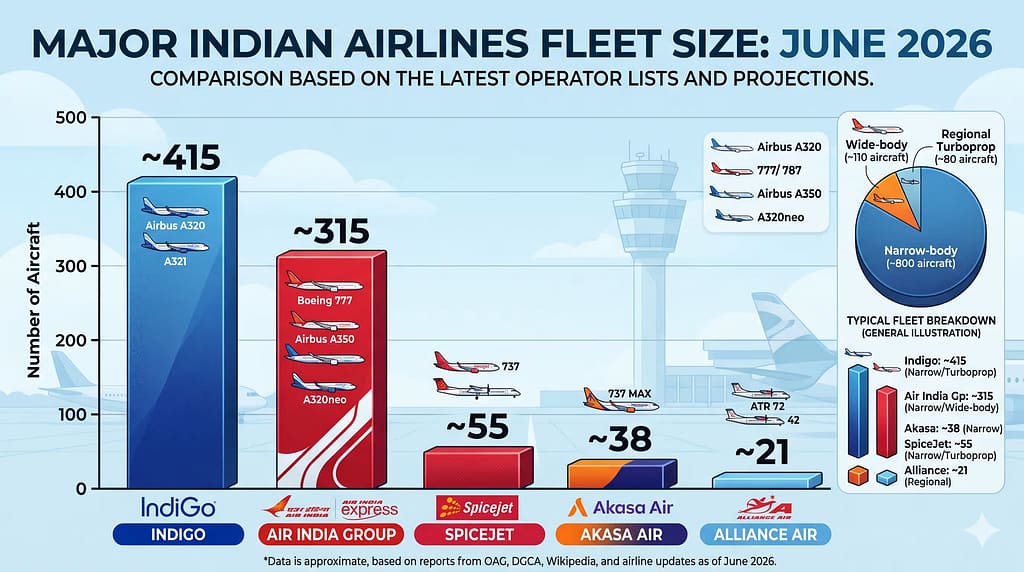
The report does not give an overall fleet growth percentage, but it clearly shows that India’s airline ecosystem is large, active, and spread across multiple aircraft types and business models. The airline mix also suggests continued demand for both metro-to-metro and regional routes.
Some useful takeaways from the list are:
- Wide-body flying is led mainly by Air India.
- Narrow-body capacity is dominated by IndiGo and Air India Express.
- Regional connectivity is being supported by Alliance Air, Star Air, FLY91, India One Air, and Skyhop Aviation.
- Cargo continues to be important through Blue Dart Aviation, Quikjet, and freighter aircraft operated by larger airlines.

Future outlook
The operator list is updated as on 31 May 2026, so the next changes will likely come through fleet additions, retirements, and possible new route launches. Airlines with newer aircraft types may use them to improve fuel efficiency, cut operating costs, and expand capacity on busy routes.
The next few months will also be important for regional aviation, because small aircraft and commuter airlines can improve access to underserved cities. If India’s passenger demand continues to rise, airlines may keep adding more aircraft and more routes, especially in the domestic market.
Conclusion
The latest operator list shows that India’s aviation market is still expanding, with a strong mix of full-service, low-cost, regional, and cargo airlines. For passengers, this should mean more options and better connectivity, while for the industry it signals continued growth in capacity and network reach.
ALSO READ: Star Air Revives Nanded Air Connectivity: Star Air Nanded Flight Routes


1 thought on “India’s Airline Fleet Hits 822 Aircraft in 2026”
Comments are closed.