

Free AD course From Basics to Advanced | Designed for Aspiring Aviation Professionals
Welcome, Students! Imagine you are travelling in an IndiGo flight from Mumbai to Delhi. Have you ever wondered — who makes sure that plane is 100% safe? One of the most powerful tools that keeps you safe on every single flight is called an Airworthiness Directive (AD). This course will teach you everything about ADs — from what they are to how experts verify compliance.
Learning Objective :
Module 1: What Is an Airworthiness Directive (AD)?
Module 2: How to Read an AD Number — FAA & EASA Decoded
Module 3: AD Applicability — Does This AD Apply to My Aircraft?
Module 4: Types of ADs
Module 5: What Is a Service Bulletin (SB)?
Module 6: Aircraft Documentation — The Paperwork Trail
Module 7: Auditing ADs — How Is Compliance Verified?
Module 8: AD Lifecycle — Corrected, Revised & Superseded
Module 9: Issue Date vs. Effective Date — Not the Same Thing
Module 10: Emergency ADs — When Safety Cannot Wait
Module 11: AMOC — Alternative Method of Compliance
Module 12: The AD Rulemaking Process — How an AD Is Born
Module 13: SIB — Safety Information Bulletin
Module 14: ADs and the MEL — Can You Defer?
Module 15: CFM Engine ADs — A Special Bilateral Case
Module 16: AD Record-Keeping — The Paperwork That Protects You
Module 17: Why an AD Can Apply Even When the Part Is Not Installed
Module 18: Dos and Don’ts
Module 19: Review — Quick Concept Checks
Module 20: Glossary — All Key Term
MODULE 1: WHAT IS AN AIRWORTHINESS DIRECTIVE (AD)?
The Big Idea
An Airworthiness Directive (AD) is an official notification issued by a government aviation authority to the owners and operators of aircraft. It informs them that a known safety problem exists in a particular aircraft, engine, APU (Auxiliary Power Unit), or component — and that it must be corrected.
Think of it like this: Suppose a car company discovers that a certain model's brakes are faulty. They issue a recall and every owner MUST fix it — or they cannot drive the car legally. In aviation, that "recall notice" is called an Airworthiness Directive.
Compliance with ADs is not optional — it is a MUST for every airline operator to keep their aircraft airworthy and legally flyable.
Why Are ADs Issued?
ADs usually result from:
- Service difficulties observed on a particular aircraft or component by manufacturers
- Reports from operators and MROs (Maintenance, Repair & Overhaul organizations)
- Investigations after aircraft accidents or incidents
When detailed investigation into these reports reveals degradation, reduced reliability, or reduced life of a component, the aviation authority releases an AD to notify all operators.
Real-World Example: In 2000, the Concorde crash in Paris was partly caused by a fuel tank design flaw. After investigation, aviation authorities issued ADs requiring inspection and modification of fuel tanks on similar aircraft — a direct example of how accidents trigger ADs.
Who Issues ADs?
Different countries have their own aviation authority that issues ADs:
| Authority | Full Name | Country/Region |
|---|---|---|
| FAA | Federal Aviation Administration | USA |
| EASA | European Aviation Safety Agency | European Nations |
| DGCA | Directorate General of Civil Aviation | 🇮🇳 India |
| CASA | Civil Aviation Safety Authority | Australia |
| TC | Transport Canada | Canada |
🇮🇳 Indian Connection: India's DGCA issues ADs for all Indian-registered aircraft. If you ever see "DGCA AD 2023-01", it means India's aviation authority has issued a safety directive. Airlines like Air India and IndiGo must comply with DGCA ADs to operate in India.
Quick Quiz: Which authority would issue an AD for a Boeing 737 operated by Air India? Think about it — Air India operates in India, so DGCA would issue it. But since Boeing is a US company, the FAA may also issue one that DGCA then adopts!
Key AD Vocabulary (Glossary)
Learn these important terms — they will appear throughout this course:
| Term | Meaning |
|---|---|
| AD Schedule | The primary list of all ADs issued for a specific aircraft or engine |
| Applicability | |
| Issue Date | The date the AD was officially published |
| Effective Date | The date from which compliance time starts counting |
| Emergency AD | An urgent AD that goes directly to owners before formal issuance |
| SB (Service Bulletin) | A document from the manufacturer describing how to fix a problem |
| SL / SIN / TNS | Service Letter / Service Information Notice / Technical News Sheet |
| SN / PN | Serial Number / Part Number — unique identifiers for each component |
| TIS / TTIS | Time In Service / Total Time In Service |
| FH / FC | Flight Hours / Flight Cycles |
MODULE 2: How to Read an AD Number — FAA & EASA Decoded
Understanding the AD number itself is a fundamental skill. Every AD number is a coded identifier that tells you exactly when it was issued and where it fits in the sequence. Let’s break both formats down.
2a. FAA AD Number Format
FAA ADs follow a three-part numbering system :
FAA AD: 2026 – 04 – 07
| Part | What It Represents | Example |
|---|---|---|
| Part 1 — Year | The calendar year in which the AD was issued | 2026 = issued in year 2026 |
| Part 2 — Biweekly Period | The bi-weekly period (fortnight number) of that year when the AD number was assigned. There are 26 bi-weekly periods in a year. | 04 = 4th bi-weekly period (approx. mid-February) |
| Part 3 — Sequential Number | A sequential number assigned within that bi-weekly period — the order in which that AD was issued among all ADs in that fortnight | 07 = the 7th AD issued in that bi-weekly period |
Real Example: FAA AD 77-23-03
77 → Issued in 1977
23 → Issued in the 23rd bi-weekly period of 1977 (around mid-November)
03 → It was the 3rd AD issued in that bi-weekly period
Modern Example: FAA AD 2026-04-07
2026 → Issued in 2026
04 → Issued in the 4th fortnight of 2026 (approximately mid-February 2026)
07 → The 7th AD issued in that fortnight
Note: Older FAA ADs used a two-digit year (e.g., 77-23-03). Modern FAA ADs use a four-digit year (e.g., 2026-04-07). Both follow the same three-part logic.
2b. EASA AD Number Format
EASA ADs follow a simpler two-part numbering system :
EASA AD: 2026 – 0120
| Part | What It Represents | Example |
|---|---|---|
| Part 1 — Year | The calendar year in which the AD was issued | 2026 = issued in year 2026 |
| Part 2 — Sequential Number | A sequential 4-digit number running continuously throughout that year — simply counting each AD from 0001 upward | 0120 = the 120th AD issued by EASA in 2026 |
Real Example: EASA AD 2026-0120
2026 → Issued in 2026
0120 → It is the 120th AD issued by EASA in the year 2026
Subject: Fuselage — Lateral Window Frame — Inspections (issued 23 June 2026, effective 7 July 2026)
Another Example: EASA AD 2007-0071
2007 → Issued in 2007
0071 → The 71st AD issued by EASA in 2007
2c. FAA vs EASA — AD Number Format Comparison
| Feature | FAA AD | EASA AD |
|---|---|---|
| Format | YYYY-BB-SS (3 parts) | YYYY-NNNN (2 parts) |
| Year | 4-digit (modern) or 2-digit (old) | Always 4-digit |
| Middle part | Bi-weekly period number (01–26) | Not present |
| Last part | Sequential within the biweekly period | Sequential across the full year (0001–9999) |
| Example | 2026-04-07 | 2026-0120 |
| Resets each year? | Yes — numbering restarts each January | Yes — numbering restarts each January |
2d. What About DGCA (India)?
India’s DGCA follows a similar pattern to EASA — a year + sequential number format. For example:
DGCA AD No. AD-AIR-2024-01 or CAR-M AD 2024-001
- The year identifies when it was issued
- The sequential number identifies its order within that year
- Many DGCA ADs are adoptions of FAA or EASA ADs with an Indian reference number added
2e. Quick Memory Trick for Students
Think of it like this:
- FAA AD = Like a date code on a product → Year · Fortnight · Count within that fortnight
- EASA AD = Like a roll number in your school → Year · Your number that year
Both systems let you instantly know when an AD was issued and how many ADs came before it in that year.
Quick Quiz:
FAA AD 2026-01-03 — When was it issued, and was it issued early or late in the year?
Answer: Issued in 2026, during the 1st bi-weekly period (first two weeks of January) — so it was issued very early in the year, and it was the 3rd AD in that first fortnight.
MODULE 3: AD APPLICABILITY — DOES THIS AD APPLY TO MY AIRCRAFT?
3a. What is Applicability?
Applicability is one of the most critical sections inside every AD document. It defines exactly which aircraft, engines, components, or serial numbers are affected by that particular directive. Before any maintenance action or compliance check is done, the very first step is always to confirm — does this AD even apply to this specific aircraft?
The AD subject line specifically identifies the Type Certificate/Design Holder of the product(s) affected. The Applicability section within the AD then lists the specific models and any special conditions — such as specific installed Part Numbers or modifications — that determine whether the AD applies.
Simple Rule: If your aircraft, engine, or component is NOT listed in the Applicability section of the AD, you do NOT need to comply with it. But you must prove and document why it does not apply.
3b. What Does an Applicability Section Look Like?
Every AD document contains an Applicability section. Here is what it typically states:
“This AD applies to [Manufacturer Name] Model [Aircraft Type], serial numbers [XXXX] through [XXXX], certificated in any category.”
Or for a component-level AD:
“This AD applies to [Engine/Part Manufacturer] Part Number [XXXX], installed on but not limited to the following aircraft: [List of Aircraft Types].”
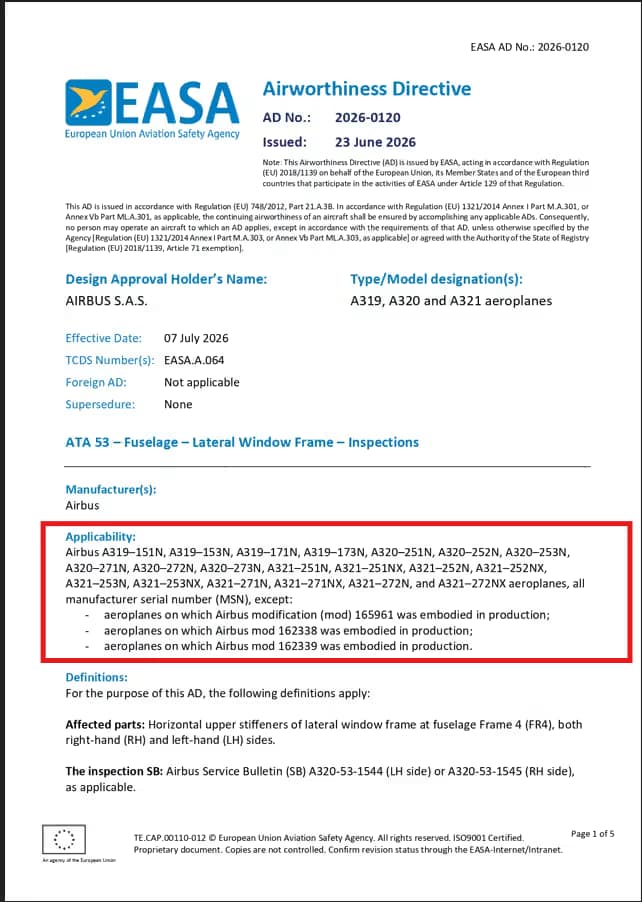
3c. How to Determine Applicability — Step by Step
Determining whether an AD applies to a specific aircraft requires a systematic check across multiple levels:
Step 1 — Gather Aircraft Details
Before opening any AD, you need:
- Aircraft Make, Model, and Series (e.g., Airbus A320-214)
- Aircraft Manufacturing Serial Number (MSN) or Line Number
- Engine type and Serial Number (ESN)
- APU Part Number and Serial Number
- Any installed appliance or equipment Part Numbers (PN)
Step 2 — Check Aircraft Type / Model
The first filter is the aircraft type. An AD for Boeing 737 does NOT apply to an Airbus A320. Always verify the exact model and series — some ADs only apply to a sub-series (e.g., A320-200 but not A320-100).
Step 3 — Check Serial Number Range
Many ADs apply only to aircraft within a specific serial number range. For example: “Applicable to MSN 0001 through 2500”
If your aircraft MSN is 2750, it falls outside this range and the AD is Not Applicable (N/A) to MSN.
Step 4 — Check Part Number / Component
Equipment ADs and Engine ADs apply to specific Part Numbers (PN). You must confirm whether the exact PN installed on your aircraft matches what is listed in the AD.
- If the installed PN matches → AD is applicable
- If a different PN is installed → AD may be N/A due to PN
Step 5 — Check Modification Status (MOD)
Some ADs are not applicable if a certain modification (MOD) was already embodied during production. For Airbus aircraft, the MOD reference is found in the Aircraft Inspection Report (AIR). For Boeing, it is in the Aircraft Readiness Log (ARL) or PRR Change List.
Example:
“This AD does not apply to aircraft on which Modification 12345 has been embodied.”
If MOD 12345 is confirmed in the AIR/ARL, the AD is N/A due to MOD embodied in production (Pre-Build)
3d. Types of Applicability — N/A Scenarios
Types of Applicability — N/A Scenarios
When an AD is confirmed as Not Applicable (N/A), the reason must be clearly documented. Here are the standard N/A categories:
| N/A Type | Reason | Proof Required |
|---|---|---|
| N/A to AC Type or Model | Wrong aircraft type | Master AD |
| N/A to MSN / Line No. / Variable No. | Serial number out of range | Master AD and/or SB |
| N/A to installed Equipment (PN/SN) | Different part installed | Master AD/SB + Component Listings |
| N/A due to SB Effectivity | SB not applicable to this aircraft | Master AD + SB |
| N/A due to MOD Embodied in Production | MOD was already done at factory | Master AD/SB + AIR MOD List or ARL/PRR Listing |
| N/A due to MOD NOT Embodied | AD requires MOD to be embodied first, and it’s not | Master AD/SB + AIR/ARL |
3e. Applicability for Different AD Types
Applicability works differently depending on the type of AD:
Airframe ADs
These apply to a particular aircraft type (e.g., all Airbus A330s). Compliance must be shown on that specific airframe. The MSN and any related MOD status are the key checks.
Equipment / Appliance ADs
These apply to a particular component (e.g., a specific landing light part number). Since the same component may be fitted on many different aircraft types, compliance must be shown at component level — meaning you check the PN/SN of the part currently installed on that aircraft.
Example: An AD is issued for a fuel pressure sensor with PN ABC-1234. If your aircraft has PN ABC-1234 installed → AD applies. If it has PN ABC-5678 → AD is N/A due to different PN installed.
Engine ADs
These apply to a specific engine type and serial number. Since engines are regularly moved between aircraft, Engine ADs follow the engine — not the aircraft. Compliance is shown on the engine records.
APU ADs
Same principle as Engine ADs — these follow the APU Serial Number and must be shown on APU documentation.
3f. Applicability and the State of Registry Rule
An important real-world point — the authority that issued an AD and the authority governing your aircraft may be different. The State of Registry (where the aircraft is registered) determines which ADs must be complied with.
Example: An Indian airline operating an Airbus A320 must comply with:
- EASA ADs — because Airbus is a European manufacturer (EASA is the State of Design authority)
- DGCA ADs — because the aircraft is registered in India (State of Registry)
If DGCA has adopted a specific EASA AD, the Indian operator must comply. If DGCA has not adopted it, technically it may not apply — but this must always be confirmed with the competent authority.
3g. A Practical Applicability Check — Indian Context
Imagine you are auditing compliance for a SpiceJet Boeing 737-800 and come across FAA AD 2022-10-05.
Here is how you check applicability:
- Type check: AD is for Boeing 737 → SpiceJet operates 737-800 → proceed
- Series check: AD specifies 737-700 and 737-800 → matches
- MSN check: AD applies to MSN 28000 through 36000 → check SpiceJet’s specific MSN
- PN check: AD references a specific brake assembly PN → check the brake PN on this aircraft
- DGCA adoption: Check if DGCA has issued a corresponding AD adopting the FAA AD
- Document the result: Record as Applicable or Not Applicable with evidence
Student Challenge: What document would you check to verify the MSN of a Boeing aircraft?
Answer: The Aircraft Readiness Log (ARL) — it is the Boeing build document that lists the MSN and all fitted components.
MODULE 4: TYPES OF ADs
Classification by Applicability
- Airframe ADs — Apply to a specific type of aircraft body (e.g., Airbus A320 or Boeing 737)
- Equipment/Appliance ADs — Apply to a specific component or equipment fitted to the aircraft
- Engine ADs — Apply to specific engine types (e.g., CFM56, Rolls-Royce Trent)
- APU ADs — Apply to the Auxiliary Power Unit (the small engine in the tail that provides ground power)
Classification by Issuance Timing
- Emergency ADs — Require immediate action; sent directly to owners
- Pre-Build ADs — The AD existed before the aircraft was manufactured; the factory fixes it before delivery
- Post-Build ADs — The AD came after the aircraft was already built; operators must fix it during operation
Example: Imagine an AD was issued in 2015 for the Airbus A330. A plane manufactured in 2014 would have a Post-Build AD (it was built before the AD, so the airline must fix it). A plane manufactured in 2016 would have a Pre-Build AD (the factory fixed it during production).
Classification by Effectivity (Current Status)
| Status | Meaning |
|---|---|
| Cancelled | The AD is no longer in effect |
| Superseded | A newer AD has replaced the old one |
| Not Applicable (N/A) | The AD doesn’t apply to this specific aircraft |
| Terminated / Closed | The required work was permanently completed |
| Open | The AD is still active and needs monitoring or future action |
Classification by Compliance Type
- One-Time — Do the task once and it’s done forever
- Recurring / Repetitive — Must be done again and again at regular intervals (like a blood test every 6 months)
MODULE 5: WHAT IS A SERVICE BULLETIN (SB)?
A Service Bulletin (SB) is a document issued by the aircraft or component manufacturer (not the government). It describes recommended or mandatory improvements, fixes, or inspections for their product.
SB vs AD — What’s the Difference?
| Feature | Service Bulletin (SB) | Airworthiness Directive (AD) |
|---|---|---|
| Issued by | Manufacturer (e.g., Airbus, Boeing, Rolls-Royce) | Government authority (FAA, EASA, DGCA) |
| Legal force | May or may not be mandatory | Always mandatory by law |
| Purpose | Product improvement or safety fix | Safety compliance |
| Who must comply | Depends on SB type | Every operator, no exception |
Types of Service Bulletins
- Alert SB — Most urgent; issued to warn of critical failures; often triggers an AD
- Mandatory SB — Compulsory within a specified time; often becomes an AD
- Recommended SB — Strongly advised but not strictly compulsory
- Optional SB — Available for those who wish to improve performance
Think of it this way: An SB is like a recommendation from a doctor. But when the government says “this is now LAW — everyone must follow it”, it becomes an AD. Most ADs refer to an SB for the actual repair instructions.
MODULE 6: AIRCRAFT DOCUMENTATION — THE PAPERWORK TRAIL
Every time maintenance is done on an aircraft, it must be documented. Think of it like a medical history folder for a patient — every operation, every medicine, every test is recorded. For aircraft, this documentation proves that an AD has been complied with.
6a. Airframe Documentation
Build Documents (When the Aircraft Was Made/Manufactured)
1. AD Compliance Report
A list of all ADs that applied to the aircraft at the time of delivery from the factory. It shows:
- AC Type and Manufacturing Serial Number (MSN)
- AD Reference Number
- Compliance Status and Remarks
2. Aircraft Inspection Report (AIR) — For Airbus Aircraft
A document listing all components fitted to the aircraft during production. It has three sections:
- Constituent Assemblies Listing
- Equipment Listing
- MOD (Modification) List
3. Aircraft Readiness Log (ARL) — For Boeing Aircraft
Same concept as AIR but for Boeing aircraft. Lists all components with their Part Number (PN) and Serial Number (SN).
4. PRR (Production Revision Records) — For Boeing
These are modification references assigned to specific Boeing SBs — equivalent to MOD References in Airbus documents.
6b. Operational Documents (During the Aircraft’s Life/Operation)
5. Job Cards / DFPs / Task Cards
These are the most important operational documents. They prove that maintenance work was actually carried out. Key contents include:
- Aircraft tail or component serial number
- Job Card Reference and Task Reference
- Component installation / removal details
- Date of task accomplishment
- Signatures and stamps
Example: If an AD requires “Inspect fuel pump every 500 Flight Hours”, the engineer will get a Job Card, do the inspection, sign it, and stamp it. That stamped Job Card becomes the proof of compliance.
6. Tech Log Page (TLP)
These are daily flight logs recording flight numbers, times, cycles, fuel, and any defects noticed during line maintenance. They also record AD/SB accomplishments done during line maintenance.
7. Non-Routine Card (NRC)
Unlike Job Cards (for scheduled work), NRCs are issued for unexpected maintenance needs — like when an engineer discovers a crack during routine inspection.
8. Authorized Release Certificate (ARC)
When a component is removed, repaired, and returned to service, an ARC is issued by an approved maintenance organization to certify the work was done correctly.
| Authority | Name of ARC |
|---|---|
| EASA | Form 1 |
| FAA | 8130-3 |
| JAA | JAA Form 1 |
| Transport Canada | TCCA 24-0078 |
6c. Engine Documentation
Engines are complex and expensive — sometimes worth more than the aircraft body! They have their own dedicated documentation.
Engine Build Documents
| Document | Engine Type | Purpose |
|---|---|---|
| DIS (Delivery Inspection Sheet) | Rolls-Royce | Lists all engine components with PN/SN and AD/SB compliance at production |
| GE Engine Brochure / As-Delivered Configuration | GE Engines | Same as DIS for GE — includes components, Life Limited Parts, and AD/SB compliance |
| EDS (Engine Data Submittal) | CFM Engines | Same concept for CFM56 engines — includes SB and AD compliance status |
Engine Operational & Shop Documents
- Engine ARC (Form 1 / 8130-3) — Certifies engine overhaul work
- AD & SB Compliance Report — Shows AD/SB status after a Shop Visit
- Engine On-Log — Lists all installed serialized parts and their status after shop
- Module Log — Lists engine modules with their total time and cycles
- Life Limited Parts (LLP) History — Tracks critical parts that have a mandatory replacement limit.
💡 What is a Life Limited Part (LLP)?
An LLP is any part that has a mandatory maximum life — after which it MUST be replaced, no exceptions. For example, engine turbine discs are LLPs because they cannot be used beyond a certain number of flight cycles due to metal fatigue.Think of it like the expiry date on a medicine — you cannot use it past that date, even if it looks perfectly fine.
6d. APU Documentation
The APU (Auxiliary Power Unit) is a small jet engine usually located in the tail of the aircraft. It provides electrical power and air conditioning when the main engines are off — like when the aircraft is parked at the gate.
Key documents:
- Acceptance Tag — Lists APU components at build time
- APU Log Book — Mandatory document tracking every APU movement and usage
- APU Shop Visit Documentation — Workshop reports, delivery report, ARC
- APU Service Record — Lists components with PN/SN and work status
- AD & SB Compliance Report — Shows compliance status post-shop
6e. Landing Gear Documentation
Landing gear (the wheels and their structure) are also tracked separately.
- Messier Dowty Delivery File Folio — Lists all landing gear components at build
- Folio 1 & 2: Lists installed components including Life Limited Parts
- Folio 3: Details of assemblies installed
- Gear Shop Visit Documentation — Workshop report, ARC, AD/SB Compliance Report
6f. On-Wing Documentation
“On-Wing” means maintenance done while the engine, APU, or gear is still attached to the aircraft — as opposed to being removed and sent to a workshop. The documents used are the same as airframe operational documents (Job Cards, TLPs, NRCs).
MODULE 7: AUDITING ADs — HOW IS COMPLIANCE VERIFIED?
What is an AD Audit?
An audit is a systematic check to verify that all ADs have been properly complied with and documented. In the aircraft leasing world, when an airline returns an aircraft at the end of a lease, a technical audit team checks every single AD.
Analogy: Imagine you rented a flat and agreed to return it in perfect condition. At the end of the lease, the landlord (called the “Lessor” in aviation) sends an inspector to check if every repair and maintenance was done. That inspection is the audit!
Documents Needed to Prove AD Compliance
To confirm that an AD has been complied with, you typically need:
- The Master AD document itself
- The Related Master SB/EOs that was referenced in the AD
- Job Cards / DFPs / Task Cards proving the work was done
- TLPs and NRCs if they were raised in connection with the work
- NDT (Non-Destructive Test) Reports if inspections were performed
- ARCs (Form 1 / 8130-3) for any replaced or modified components
- Current Component Listings to confirm what is currently fitted
7a. Understanding the AD Status
Airlines maintain a Latest AD Status — a spreadsheet or system (AMOS) report listing every applicable AD and its compliance details.
Mandatory columns in an AD Current Status:
| Column | What It Means |
|---|---|
| AD Ref. Number | The unique ID of the AD (e.g., EASA AD 2015-0176) |
| Revision | The version of the AD |
| Subject / Description | What the AD is about |
| Compliance | Work Order number or how it was complied with |
| Interval | How often it needs to be repeated |
| Last Done | When was it last done? (Date, Flight Hours, Cycles) |
| Next Due | When must it be done next? |
| Status | Open / Closed / N/A etc. |
| Remarks | Additional operator notes |
7b. Calculating Compliance Due Dates
For Repetitive ADs, you must calculate when the next compliance is due by tracking aircraft usage.
Worked Example:
Aircraft current Flight Hours (FH): 27,551 | Flight Cycles (FC): 15,698
Lease End Date (EOL): 15 January 2016
Average monthly usage: FH = 290 | FC = 145
Remaining months until lease end: 3
Projected usage in 3 months: FH = 290 × 3 = 870 | FC = 145 × 3 = 435
Projected FH at EOL: 27,551 + 870 = 28,421
Projected FC at EOL: 15,698 + 435 = 16,133
Now, if an AD is due at 28,000 FH, the team knows it will fall due before the lease ends and must be accomplished in advance!
7c. AD Audit Criteria — Case by Case
Case 1: Cancelled / Superseded ADs
| Situation | Documents Needed |
|---|---|
| Cancelled with no replacement | Master AD with cancellation notice |
| Superseded by a new AD | Master AD of the superseding AD (or both if required) |
Case 2: Not Applicable (N/A) ADs
| Reason for N/A | Documents Needed |
|---|---|
| Does not apply to this aircraft type/model | Master AD |
| Does not apply to this specific MSN or Serial No. | Master AD and/or SB |
| Different component is installed | Master AD/SB + Component Listings |
| MOD was/was not done in production | Master AD/SB + AIR/ARL/PRR listing |
Case 3: Terminated / Closed ADs
| Situation | Documents Needed |
|---|---|
| Terminated during operation (Post-Build) | Master AD/SB + Job Cards + TLP/NRC (if needed) + ARC (if components replaced) |
| Terminated during production (Pre-Build) | Master AD/SB + AD Compliance Status from Manufacturer |
| Engine AD terminated in Shop Visit | Master AD/SB + Shop AD/SB Compliance Report + Engine ARC + Component ARCs |
Case 4: Open ADs
| Situation | Documents Needed |
|---|---|
| Open with Threshold (first-time) requirement | Master AD/SB — verify compliance time not yet due |
| Open with Repeat requirement | Job Cards + TLP/NRC + ARC for last performance; verify Next Due is within acceptable window |
Golden Rule for Open ADs: If an Open or Repetitive AD is falling DUE within the aircraft’s lease clearance window (the agreed buffer period), it must be completed before the aircraft is returned. Operating with unresolved ADs can lead to the airline losing its operating license.
MODULE 8: AD LIFECYCLE — CORRECTED, REVISED & SUPERSEDED
Why ADs Get Updated
An AD is not always final forever. As more data comes in from operators, or if an error is found in the original document, aviation authorities update ADs. There are three types of updates — and students must know the difference because each one affects compliance differently.
The Three Types of AD Updates
| Update Type | What Changes | New AD Number? | Old Compliance Still Valid? |
|---|---|---|---|
| Corrected | Only a typo or printing error is fixed — no change to actual requirements | ❌ Same number | ✅ Yes |
| Revised | Requirements become less strict — e.g., extended time limit, reduced scope | ❌ Same number + R1, R2 | ✅ Yes |
| Superseded | Requirements become more strict — expanded applicability or tighter interval | ✅ Brand new AD number | ❌ Must comply with new AD |
The Golden Rule: If the authority is making it easier for operators → it gets revised (same number). If it’s making it harder or more urgent → it gets superseded (new number). This protects operators from unexpectedly stricter requirements without clear notice.
Real-World Examples
Corrected: EASA AD 2025-0045 has a wrong aircraft model name in the title. EASA republishes it as a corrected version — same number, no action required from operators beyond noting the correction.
Revised: An AD originally required inspection every 200 Flight Cycles. New data from operators shows 300 FC is safe. EASA revises it — the AD becomes 2025-0045R1. Operators who already complied under 200 FC intervals are still compliant.
Superseded: The same AD is later found to need expansion to additional aircraft serial numbers. A brand new AD is issued — 2026-0099. The old AD 2025-0045R1 is now superseded. ALL operators must check the new AD from scratch.
Quick Quiz: An AD says “This AD supersedes AD 2018-0234R2.” How many times was the original AD updated before being superseded?
Answer: Twice — first as R1 (first revision), then as R2 (second revision), and then finally replaced by a superseding AD.
MODULE 9: ISSUE DATE vs. EFFECTIVE DATE — NOT THE SAME THING
The Confusion That Grounds Aircraft
One of the most common mistakes made by junior compliance officers is confusing the Issue Date with the Effective Date. This mistake can lead to wrong “Next Due” calculations — and an aircraft being grounded, or worse, operating with an overdue AD.
Definitions
| Term | Meaning |
|---|---|
| Issue Date | The date the AD was officially signed and published by the authority |
| Effective Date | The date from which ALL compliance times begin counting |
Critical Rule: Every compliance interval — whether in Flight Hours, Flight Cycles, or Calendar Days — starts counting from the Effective Date, NOT the Issue Date.
Why Is There a Gap Between the Two?
Authorities deliberately create a gap between Issue and Effective dates to give operators time to:
- Receive and read the AD
- Order required parts or tooling
- Plan maintenance downtime
- Train engineers on the required task
This gap is typically 14 to 30 days for standard ADs. For Emergency ADs, the effective date may be the same day or even immediate upon receipt.
Visual Timeline
23 June 2026 7 July 2026 6 August 2026
| | |
ISSUED EFFECTIVE Compliance Due
(AD published) (Countdown starts) (30 days after effective)
Real Example: EASA AD 2026-0120
Issue Date: 23 June 2026
Effective Date: 7 July 2026
If the AD requires compliance within 30 calendar days of effective date, the deadline is 6 August 2026 — not 23 July 2026.
Student Exercise: An AD is issued on 1 March 2026 and becomes effective on 15 March 2026. It requires inspection within 500 Flight Hours of the effective date. Your aircraft had 10,000 FH on 15 March 2026. By what FH must the inspection be done?
Answer: 10,000 + 500 = 10,500 FH. The aircraft must be inspected before it reaches 10,500 Flight Hours.
MODULE 10: EMERGENCY ADs — WHEN SAFETY CANNOT WAIT
What Makes an AD an “Emergency”?
A standard AD goes through months of consultation and rulemaking (as you will read in Module 14 on the NPRM process). But sometimes a safety threat is so immediate and severe that there is no time for that process. This is when an Emergency AD (EAD) is issued.
How Emergency ADs Are Different
| Feature | Standard AD | Emergency AD |
|---|---|---|
| Rulemaking process | Full NPRM/PAD consultation | Bypassed entirely |
| Time to issue | 6–18 months | Hours to days |
| Effective date | Usually 14–30 days after issue | Immediate — often same day or upon receipt |
| Compliance time | Weeks to months | Before the next flight, or within hours |
| Legal basis | 14 CFR Part 39 (FAA) / Part 21 (EASA) | Emergency authority provisions |
The Emergency AD Lifecycle
- Unsafe condition discovered — through an accident, incident, or critical test finding
- Authority issues Emergency AD — sent directly to registered owners and operators via telegraph, fax, email, or authority portals
- Operators comply immediately — aircraft may be grounded until compliance is proven
- Authority finalizes the AD — the Emergency AD is replaced by a formal “Final Rule” AD
- Compliance already done counts — any work done under the Emergency AD is still valid under the Final Rule AD.
Real-World Example: After an in-flight engine separation event, the FAA issued an Emergency AD requiring all operators of that specific engine type to perform a borescope inspection before the very next flight. Airlines worldwide grounded aircraft overnight to comply.
Student Note: When an Emergency AD arrives, there is no time for meetings or approvals. The aircraft does not fly until compliance is shown. This is the highest urgency level in aviation maintenance.
MODULE 11: AMOC — ALTERNATIVE METHOD OF COMPLIANCE
What If You Cannot Do It Exactly as Written?
Every AD specifies an exact method of compliance. But sometimes an airline or MRO faces a situation where following the AD exactly as written is physically impossible or impractical. For example:
- The special tool specified in the AD is not available in India
- The replacement part referenced in the AD is discontinued
- The access procedure described does not match the actual aircraft configuration
In such cases, the operator can apply for an AMOC — Alternative Method of Compliance.
What Is an AMOC?
An AMOC is a written approval from the aviation authority permitting an operator to satisfy the requirements of an AD using a different method than what the AD originally specifies — provided the alternative achieves the same level of safety.
🔑 Important: You CANNOT simply decide your own AMOC. It must be formally applied for and approved in writing before you use it. Using an unapproved alternative method means the AD is considered not complied with — even if your method was technically sound.
AMOC Process — Step by Step
- Identify the problem — determine exactly which part of the AD cannot be followed as written
- Develop an alternative — work with your engineering team and the manufacturer to propose an equivalent method
- Submit application — send to FAA (via AMOC request), EASA (via deviation request), or DGCA
- Authority review — the authority evaluates whether the alternative achieves equivalent safety
- Written approval received — ONLY after receiving written approval can the alternative method be used
- Document everything — the AMOC reference number must be recorded in the AD compliance record
AMOC vs. Standard Compliance
| Feature | Standard AD Compliance | AMOC Compliance |
|---|---|---|
| Method | Exactly as written in AD | Authority-approved alternative |
| Approval needed | No — follow the AD | Yes — written AMOC approval mandatory |
| Record keeping | AD reference + job card | AD reference + AMOC approval + job card |
| Legal validity | Fully compliant | Fully compliant if AMOC is approved |
Indian Context: A DGCA-approved MRO in Chennai is working on an Air India aircraft. The AD requires using a specific Boeing Ground Support Equipment (GSE) tool to check a hydraulic fitting. That tool is not available in India. The MRO applies for an AMOC, proposing an alternative test rig that measures the same parameters. DGCA reviews and approves. The MRO can now proceed using the approved alternative — and must record the AMOC number in the job card.
Quick Quiz: An engineer finds he cannot source the specified replacement part. He uses a “similar looking” part from another manufacturer without applying for an AMOC. Is the AD complied with?
Answer: NO. The AD is NOT complied with — regardless of whether the part is functionally similar. Without a written AMOC approval, any deviation from the AD’s specified method is non-compliance.
MODULE 12: THE AD RULEMAKING PROCESS — HOW AN AD IS BORN
From Problem to Published AD
Most students only see the final AD document. But understanding how an AD comes to exist gives you a much deeper appreciation of why every word in an AD matters. Here is the full journey:
FAA — The NPRM Process
The FAA follows a formal rulemaking process governed by the US Administrative Procedure Act:
Step 1 — Unsafe Condition Identified
A problem is discovered — through an incident report, manufacturer data, in-service failure, or accident investigation.
Step 2 — FAA Drafts the AD
The FAA’s Aircraft Certification Office reviews the data and drafts an AD.
Step 3 — NPRM Published
An NPRM (Notice of Proposed Rulemaking) is published in the US Federal Register. This is a public notice saying: “We are planning to issue this AD — here are the details.”
Step 4 — Public Comment Period (30–60 days)
Airlines, manufacturers, MROs, pilots, and the public can submit comments — supporting, opposing, or suggesting changes to the proposed AD.
Step 5 — FAA Reviews Comments
The FAA reviews all comments and may modify the AD based on valid technical feedback.
Step 6 — Final Rule AD Published
The finalized AD is published in the Federal Register as a binding regulation. It carries a new Docket Number.
Total time: typically 6 to 18 months for a standard AD.
EASA — The PAD Process
EASA follows a similar but slightly different process:
Step 1 — Unsafe Condition Identified
EASA receives data from operators, NAAs (National Aviation Authorities), or the manufacturer.
Step 2 — PAD Published
EASA publishes a PAD (Proposed Airworthiness Directive) on its safety publications portal — the European equivalent of an NPRM.
Step 3 — Comment Period
Stakeholders submit feedback within the open consultation window.
Step 4 — Final AD Issued
EASA issues the final AD, incorporating valid feedback.
FAA vs. EASA Rulemaking Comparison
| Step | FAA | EASA |
|---|---|---|
| Draft notice | NPRM (Notice of Proposed Rulemaking) | PAD (Proposed Airworthiness Directive) |
| Published in | US Federal Register | EASA Safety Publications Portal |
| Comment period | 30–60 days | Typically 28–60 days |
| Total duration | 6–18 months | 6–12 months |
| Emergency bypass | Emergency AD — skips entire process | Emergency AD — skips entire process |
Why does this matter for auditors? When reviewing a superseded AD, auditors sometimes check the NPRM or PAD to understand why the AD was changed — especially when a revision reduced compliance requirements. The reasoning is recorded in the rulemaking docket.
MODULE 13: SIB — SAFETY INFORMATION BULLETIN
The Warning Before the Mandate
Before EASA or the FAA decides to issue a mandatory AD, they sometimes issue a gentler notification called a SIB (Safety Information Bulletin) — or its FAA equivalent, the SAIB (Special Airworthiness Information Bulletin).
What Is a SIB?
| Feature | AD | SIB / SAIB |
|---|---|---|
| Legal force | Mandatory by law | Not mandatory — advisory only |
| Issued by | EASA / FAA | EASA (SIB) / FAA (SAIB) |
| Compliance | Required by a specific deadline | Strongly recommended but optional |
| Purpose | Correct a confirmed unsafe condition | Warn of a potential issue under investigation |
| Consequences of ignoring | Aircraft grounded / legal penalties | No direct legal penalty — but risk remains |
Why Should Operators Take SIBs Seriously?
A SIB often signals that EASA or FAA is actively investigating a problem. In many cases, a SIB is the first step before a mandatory AD is issued. Operators who ignore a SIB may find themselves scrambling for compliance when the same subject becomes a mandatory AD — with a tight compliance deadline.
Example: EASA issued a SIB warning of potential corrosion on a specific fuselage frame. Six months later, after more reports came in confirming the issue, EASA issued a mandatory AD for the same subject — with a 90-day compliance deadline. Airlines that had already acted on the SIB were ahead. Those that ignored it had to rush.
Best Practice for Compliance Teams: Always maintain a SIB tracker alongside your AD Schedule. SIBs should be reviewed quarterly and flagged for potential conversion to mandatory ADs.
Quick Quiz: Your airline receives a SAIB from the FAA about potential cracking in a brake component. Must you comply?
Answer: Technically no — SAIBs are not mandatory. But it is strongly advisable to investigate and act, because this SAIB may become a mandatory AD. Document your review either way.
MODULE 14: ADs AND THE MEL — CAN YOU DEFER?
What Is the MEL?
The MEL (Minimum Equipment List) is a document that allows an aircraft to operate with certain systems or components temporarily out of service — under specific conditions and for a limited time. Think of it as a list of items that can be “deferred” for repair without grounding the aircraft.
Example: If an in-flight entertainment screen fails, the MEL allows the aircraft to fly with that screen inoperative for up to 10 days while a repair is arranged. The aircraft is still airworthy.
Can an AD Action Be Deferred Using the MEL?
This is one of the most frequently asked questions in real-world compliance audits:
General Rule: NO — AD actions cannot be deferred using the MEL unless the AD itself explicitly states that MEL deferral is permitted.
If an AD requires an action, that action must be completed by the compliance deadline — regardless of the MEL status of any related system.
Exceptions — When MEL Deferral IS Permitted
There are limited cases where MEL-based deferral is allowed:
| Scenario | Rule |
|---|---|
| AD explicitly permits MEL deferral | Only if the specific AD contains written language authorizing MEL deferral |
| ALS (Airworthiness Limitations Section) corrective actions | Special exception where deferred rectification may be permitted under MEL conditions, provided the AD does not prohibit it |
Key Lesson: Never assume an AD can be deferred on MEL grounds. Always read the AD’s compliance section word for word. If it does not explicitly mention MEL deferral, it is not permitted.
Real Audit Scenario: An auditor finds that an aircraft’s AD for a fuel quantity indicator was marked “deferred — MEL item” in the operator’s records. The AD did not mention MEL deferral. Is this acceptable?
Answer: No. This is a finding — the AD was not complied with by the required deadline, and the MEL deferral was not authorized. The aircraft should not have been operated past the AD due date.
MODULE 15: CFM ENGINE ADs — A SPECIAL BILATERAL CASE
What Makes CFM Engines Different?
CFM International is a joint venture between:
- GE Aviation (USA) — American company
- SAFRAN Aircraft Engines (France) — European company
Their engines — the CFM56 (used on Boeing 737 and Airbus A320) and the LEAP-1 (used on A320neo and 737 MAX) — power thousands of aircraft worldwide. But because the engine is jointly designed by a US and a European company, both FAA and EASA consider themselves the State of Design authority for CFM engines.
What This Means for ADs
Unlike most aircraft — where one authority issues ADs and others adopt them — for CFM engines, FAA and EASA each issue their own separate ADs on the same engine:
- FAA issues CFM ADs for US-registered aircraft
- EASA issues its own CFM ADs for EASA-registered aircraft
- They do NOT simply adopt each other’s AD — they may have different compliance times, applicability, or instructions
Which AD Applies to Indian Airlines?
For Indian operators (like IndiGo, Air India, SpiceJet) operating CFM-powered aircraft:
- Their aircraft are registered in India (DGCA is State of Registry)
- DGCA must officially determine whether to follow FAA or EASA CFM ADs — and publish this guidance
- In practice, DGCA typically aligns with the EASA CFM ADs for Airbus-operated CFM engines and FAA CFM ADs for Boeing-operated CFM engines — but this must always be confirmed with the current DGCA advisory circulars.
Student Challenge: IndiGo operates an Airbus A320 with CFM56-5B engines registered in India. An FAA AD is issued for the CFM56-5B. Must IndiGo comply?
Answer: Not automatically. IndiGo must check if DGCA has adopted that FAA AD. DGCA may issue its own corresponding AD, or direct operators to follow the EASA CFM AD on the same subject instead.
MODULE 16: AD RECORD-KEEPING — THE PAPERWORK THAT PROTECTS YOU
Why Record-Keeping Is as Important as the Work Itself
In aviation, a job that is done but not documented does not exist in the eyes of the law. This principle is especially critical for AD compliance. An aircraft can have every AD perfectly accomplished — but if the records are incomplete, missing, or incorrectly filled, the aircraft can be:
- Rejected at lease return — costing the airline millions in penalties
- Grounded by the authority — if records cannot prove airworthiness
- Involved in liability disputes — if an incident occurs and records are inadequate
What Must Be Recorded for Every AD
Per FAA 14 CFR 91.417 and EASA Part-M M.A.305, every AD compliance record must include:
| Required Entry | Details |
|---|---|
| AD Number and Revision | Full reference (e.g., EASA AD 2026-0120) |
| Compliance method | How it was done — Job Card number, SB reference |
| Date of compliance | Exact calendar date |
| Flight Hours at compliance | Aircraft total FH when work was done |
| Flight Cycles at compliance | Aircraft total FC when work was done |
| For repetitive ADs: Next Due | Next due date, FH, or FC clearly stated |
| Certifying signature | Engineer’s signature |
| License/Approval number | Engineer’s license number and organization approval |
Recurring AD Record — The Most Critical
For a Repetitive AD, the record must always show both:
- Last Done — When was it last accomplished? (Date, FH, FC)
- Next Due — When must it next be accomplished? (Date, FH, or FC — whichever comes first)
Example Record Entry:
AD: EASA 2020-0145 | Task: Engine vibration sensor inspection
Last Done: 15 April 2026 | FH: 22,450 | FC: 11,200
Interval: Every 600 FH or 12 calendar months, whichever first
Next Due: 23,050 FH OR 15 April 2027 — whichever occurs first
The Lease Return Impact
During aircraft lease returns, a complete AD records review is performed. Incomplete AD records are one of the top three reasons aircraft are delayed or penalized at lease return. Every missing job card, every undated entry, every unsigned task can result in:
- Re-accomplishment of the task (costly, time-consuming)
- Financial penalty from the aircraft owner (lessor)
- Extended lease return period
Professional Tip: Maintain a shadow AD records file — a digital copy of all AD compliance documents organized by AD number. This makes audits significantly faster and prevents last-minute scrambles during lease return.
MODULE 17: WHY AN AD CAN APPLY EVEN WHEN THE PART IS NOT INSTALLED
A Question That Surprises Every Student
Here is a scenario that confuses almost everyone new to AD compliance:
An AD is issued for fuel pump Part Number XYZ-1234. Your aircraft currently has fuel pump Part Number XYZ-5678 installed. The AD says it applies to your aircraft type. Why does it still appear on your AD Schedule — even though the specified part is not on your aircraft?
The Official Explanation
Aviation authorities explain this clearly: An AD applies to all aircraft for which installation of the affected part is ELIGIBLE — not just aircraft where it is currently installed.
The reason: the unsafe part could potentially be installed on your aircraft in the future — during maintenance, at a shop visit, or during a component swap. The AD protects against that possibility.
What This Means in Practice
When such an AD appears on your schedule, it may contain one of these instructions:
| AD Instruction | What It Means |
|---|---|
| Prohibition to install | That PN must never be fitted to your aircraft — ever |
| Inspect if installed | Only take action if that specific PN is currently fitted |
| Replacement before next flight if installed | Immediate action only if the unsafe PN is currently on the aircraft |
| Conditionally applicable | Applies only when/if that PN is installed |
How to Handle It in Your AD Schedule
When the current Part Number does NOT match the AD’s specified PN:
- Record it as N/A — different PN currently installed
- Attach the Component Listing showing the current PN as evidence
- Do not close the AD permanently — it must be re-checked every time a new component is installed on that position
- At every shop visit or component change, verify again whether the replacement part matches the AD’s PN
Example: An AD for landing gear actuator PN A-100 states: “Do not install PN A-100 on any aircraft.” Your aircraft currently has PN A-200 installed. You record it as N/A. But at the next gear overhaul, if a shop tries to fit PN A-100 — the AD prohibits this installation. Your records protect you.
Audit Scenario: An auditor sees an AD for a specific seat component PN listed as permanently “Terminated — different PN installed” in the records from 5 years ago. Since then, the aircraft had a full cabin refurbishment. Is this acceptable?
Answer: No. The AD status should have been re-verified after the cabin refurbishment. If the new seats installed a matching PN, the “N/A” status is now incorrect. This is an audit finding — AD statuses must be reviewed after any relevant component change.
MODULE 18: DOs AND DON’Ts
✅ DOs
- Always review every attached compliance document thoroughly before approving
- Respond to queries at the earliest once the concern is sorted
- Cross-reference other tabs/sections for more accurate information
- Follow correct procedures when uploading or updating status
- Search manually if a document is not found in automated search
❌ DON’Ts
- NEVER edit current status entries without written confirmation from senior management
- NEVER upload Master documents directly to individual rows — they must first go to the Document Management Centre (DMC)
- Do not respond to client/lessor notes without senior confirmation (especially at junior level)
- Do not skip manual search if automated search fails
MODULE 19: REVIEW — QUICK CONCEPT CHECKS
Test your understanding with these questions!
❓ Question 1: A Boeing 737 operated by SpiceJet has an AD issued by EASA. Must SpiceJet comply with it?
Answer: It depends! If India’s DGCA adopts the EASA AD, SpiceJet must comply. Different regulatory authorities may issue their own version of the same AD.
❓ Question 2: An engine overhaul was completed 3 years ago. What document proves the work was airworthy?
Answer: The Authorized Release Certificate (ARC) — specifically an EASA Form 1 or FAA 8130-3.
❓ Question 3: An AD requires inspection every 300 Flight Cycles. Last done at 12,000 FC. Current is 12,250 FC. Is this overdue?
Answer: No! Next due = 12,000 + 300 = 12,300 FC. Current is 12,250. Still within limits — but it’s very close!
❓ Question 4: What is the difference between a Terminated AD and a Closed AD?
Answer: Both indicate the required action is permanently complete. A Terminated AD means the one-time work is done; a Closed AD refers to repetitive compliance that has been permanently resolved, often through modification.
MODULE 20: GLOSSARY — ALL KEY TERMS
| Term | Full Form | Meaning |
|---|---|---|
| AD | Airworthiness Directive | Mandatory safety notice from aviation authority |
| SB | Service Bulletin | Manufacturer’s maintenance/improvement notice |
| ARC | Authorized Release Certificate | Certificate confirming airworthy work was done |
| LLP | Life Limited Part | Part with mandatory replacement at set hours/cycles |
| MRO | Maintenance, Repair & Overhaul | Certified organization performing aircraft maintenance |
| TLP | Tech Log Page | Daily aircraft maintenance and flight log |
| NRC | Non-Routine Card | Document for unscheduled maintenance |
| DFP | Defect File Part | Another term for Job Card used at certain organizations |
| MSN | Manufacturing Serial Number | Unique ID for each Airbus aircraft |
| FH / FC | Flight Hours / Flight Cycles | Measures of aircraft usage |
| EOL | End of Lease | Date the aircraft is returned to the owner |
| EASA | European Aviation Safety Agency | EU aviation authority |
| FAA | Federal Aviation Administration | US aviation authority |
| DGCA | Directorate General of Civil Aviation | Indian aviation authority |
| APU | Auxiliary Power Unit | Small tail-engine providing ground power |
| AIR | Aircraft Inspection Report | Airbus component listing at delivery |
| ARL | Aircraft Readiness Log | Boeing component listing at delivery |
| DMC | Document Management Centre | Central repository for Master documents |
CAREER PATH IN AVIATION RECORDS & COMPLIANCE
Understanding ADs opens doors to careers including:
- Aircraft Records Analyst — Manage and audit aircraft documentation
- Technical Records Engineer — Ensure compliance of AD records during aircraft transitions
- MRO Documentation Specialist — Handle job cards and release certificates
- Aviation Lease Auditor — Conduct full technical audits during aircraft lease returns
- DGCA Inspector — Work for India’s civil aviation authority.
🎯 India’s aviation sector is one of the fastest growing in the world. Airlines and MROs across India need thousands of trained professionals in technical records and airworthiness compliance every year.
This course is intended for educational purposes to help students understand the principles of aircraft airworthiness compliance. For official aviation training and certification, please refer to DGCA-approved training organizations.
We Would Love to Hear From You!
Thank you for completing the Airworthiness Directives (ADs) Course by Airline360. Your honest feedback is extremely valuable to us — it helps us improve the content, add new topics, and make the learning experience better for thousands of students across India and beyond.
Please share your feedback by email: info.airline360@gmail.com
Found this course helpful? Share it with a friend who dreams of a career in aviation!
© COPYRIGHT NOTICE
© 2026 Airline360. All Rights Reserved.
This course material — including all text, examples, tables, module content, diagrams, and explanatory notes — is the exclusive intellectual property of Airline360.
Unauthorized copying, reproduction, distribution, republication, uploading, posting, or transmission of any part of this material — in any form or by any means (electronic, mechanical, photocopying, recording, or otherwise) — is strictly prohibited without prior written permission from Airline360.
This content has been developed solely for educational purposes to assist students in understanding aviation airworthiness compliance principles. It is not a substitute for official regulatory documents, DGCA-approved training, or guidance from a licensed aviation professional.
For permissions, partnerships, or licensing enquiries:
📧 info.airline360@gmail.com
🌐 https://airline360.in
Aviation regulations referenced in this course (FAA 14 CFR Part 39, EASA Part-M, DGCA CARs) are publicly available government documents. All interpretations, examples, analogies, and course structure are original works created by Airline360.








1 thought on “Airworthiness Directives (ADs) Complete Course”
Comments are closed.